

What's the news about the On-Line Nomogram?
1) Ring segment indications
for the 220 arc length degrees;
2) Two segments indications in eyes with high astigmatism;
3) Segment thickness "Up-grade" in high miopic eyes;
4) New exhibition window for the suggested segments;
5) Alarm in cases when a very thick segment is suggested for a thin cornea;
6) Instructions for each corneal value;
Congratulations! this success is your sucess!
1) Ring segment indications for arc lenght of 220 degrees;
The traditional Ring Segment, with arc length of 155 degrees, modifies the
eye astigmatism moving up the extremities where they are located.
That's why we let the segment extremities positioned under the
steepest corneal meridian, reducing the keratometric astigmatism. In
some eyes, this feature can become a problem. Therefore, when
the eye does not have a high astigmatism, the traditional
segment with arc lenght of 155 degrees will create one (iatrogenic
astigmatism). This happens with a certain frequency, for example,
in central "nipple" keratoconus.
Using
this knowledge, a special ring segment was created
for this specific kind of eyes. This segment is bigger than the previous ones, with arc lenght
of 220 degrees. During the last
years, worldwide ophthalmologists had tested
this new 220 ring (length = arc lenght of 220 degrees), which showed
good
results in cases with small or absent CORNEAL astigmatism
(we must consider the astigmatism showed in the Topographic Map
Simulated Keratometry and not the refracional one).
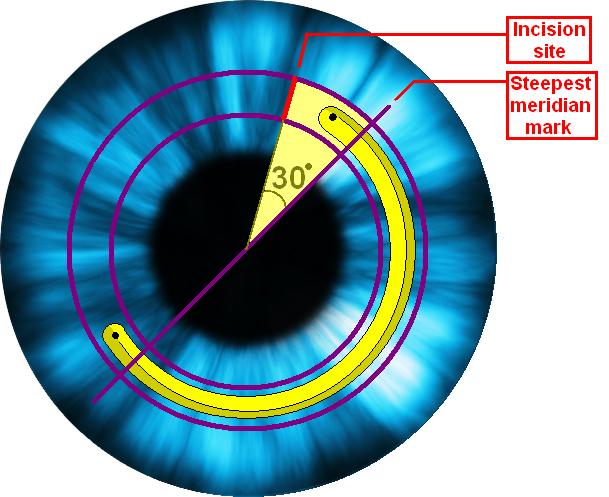
Thus, this new software (2010 version) will show the option to use this special 220 arc Ring every time the córnea shows no or a small astigmatism (up to
1,5
diopters). Of course, in these cases, you have to use only 1 segment and the tunnel
must to be
made bigger that the usual one. The incision have to be made far
from the steepest meridian mark (distance: approximately 30 degrees
far from this mark - to see figure below). That's because each
segment extremitt will cross the steepest meridian
in 15 degrees.
|
|
Important: The use of the 220 arc lenght segment remains on research. We will take care to keep you informed about this new Ring indications/contraindications. Please, tell us about your personal experience using this new device. The responsible ophthalmologist for the surgery must decide between using the traditional 155 degrees ring segment or new 220 ring segment, also using each eye specific features.
2) Two segment indications in eyes with high astigmatism;
We know that the 155 degrees segment extremities produce an up-side force flatening the meridian where they had been placed. We use this phenomenon for the correction of the corneal astigmatism. However, when the astigmatism is very high, only one ring segment becomes insufficient to induce a substantial correction. That's why, the 2010 Version On-line Nomogram, always will suggest the use of 2 segments when the astigmatism will be higher that 5 dioptrias, even in the descentered keratoconus cases (just like when the ectasic area distribution is classified as type 1 or 2).
3) Segment thickness "Up-grade" in high miopic eyes;
This new nomogram version, in cases of very high nearsightedness (the borderline diopter value was costumized for each keratometric measurement band), will suggest the use of a segment immediately thicker than "the standard" model. This was an old ophthalmologists claim, desiring a little more consistent and perceivable result in high myopic cases.
4) New exhibition window for the suggested segments;
With the aim to become simpler, clear and easier to show the suggested segments data, an individual windows was created for each segment. In the segments data right side, some important informations about that specific surgery are showed.
5) Alarm in cases when a thick segment is suggested for a thin cornea;
We know
nowadays that a thick segment
in a thin cornea produces metabolic changes, responsible to the cells suffering.
That's why, in these cases, we can see a thin
epithelium above the ring or even we can see desepithelised
areas. The corneal surface irregularities, typical finding in
this eyes, reduce the corneal optic quality turning the visual
surgery results worse. To avoid this kind of situation, we recommend:
not to use segments whose thickness exceeds 50% of the corneal
paquimetry value in the tunnelization area. The
evaluation of a paquimetric map (from an Orbscan or Pentacam)
or the accomplishment of ultrasonic paquimetric measurements (before
or during the surgery) are important, throughout all the
tunnelization area, in order to find which is the cornea
thinnest point in this area. It is important to understand that
we have to look for the tunnelization area thinnest point,
not the entire cornea thinnest point.
This
new 2010 version will emit an alarm signal, every time
the suggested segment shows a thickness higher than 50% of the
cornea paquimetric measurement throughout all the
tunnelization area. For this action, the supply
of this last value is necessary. We recommend and insist
that, in these cases when you see this alarm signal, the
suggested segment by the software must be substituted by a
thinner one.
6) Instructions for each corneal value;
By the side of each field for data insertion, you will find the word: "Instruction" with hiperlink to pages with important informations .
7) Using segments with reduced arc lenght.
The corneal ring segments have been used especially for astigmatism correction.
When a segment is implanted into the corneal stroma, its edges
tend to force the cornea upward and this effect produces a
flattening of this corneal meridian.
We use this phenomenon to correct the corneal
astigmatism:
In recent years, some doctors started to find, in selected cases,
interesting results when using corneal ring segments with
reduced arc length.
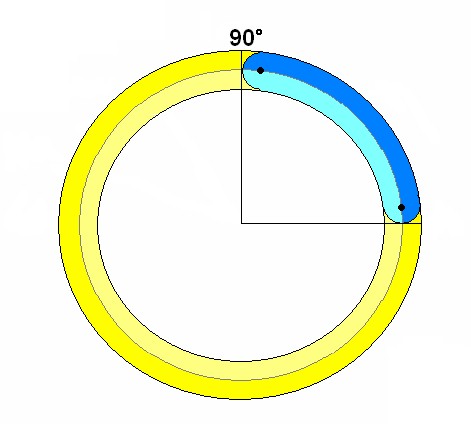
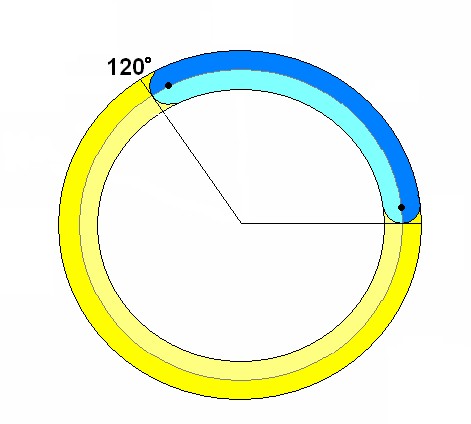
While the traditional Cornealring segment has 155
degrees of arc length, these new segments are being tried with
90 and 120 degrees of arc.
Now, Cornealring segments has several arc lengths: 90,
120, 155 and 220 degrees.
The small segments (90 and 120 degrees) appear to be
useful in the correction of astigmatism and do not promote
significant change in spherical refraction.
Thus, this small segments seem best suited for
patients with:
• hyperopia + astigmatism
• low or no myopia + astigmatism
According to the "Barraquer Law”, the keratometric flattening is
proportional to the volume of the material implanted into the
corneal periphery.
This means that a myopic eye shows a refractive
reduction with the rings. In the other hand, a hyperopic eye
shows a refractive increase with the ring surgery. In this last
case (hyperopic eye) one can use a ring with reduced arc length
(90 and 120 degrees) to avoid the increase of the hyperopia.
It is important to remember that there are no well-controlled
studies with adequate sampling showing that small arc lengths
are efficient for a keratoconus stabilization.
The "On-Line Nomogram Cornealring" was changed and now, it also indicates the use of segments of 90 and 120 degrees of arc in special cases.
Option regarding the use of segments of 90 and 120 degrees of arc:
The use of segments of 90 and 120 degrees of arc is a surgeon choice.
He must evaluate all the patient clinical details to choose: small segments or the standards segments (155 degrees of arc). In the latter case, it is advisable to use the segment of 155 degrees of the same thickness as suggested for its corresponding 90 or 120 degrees.
Example: When the nomogram suggest a segment of an arc of 120 degrees and 200 microns thick,
the surgeon may (when appropriate) replace it using an arc of 155 degrees and 200 microns thick.
Using the case with segments of 90 and 120 degrees of arc.
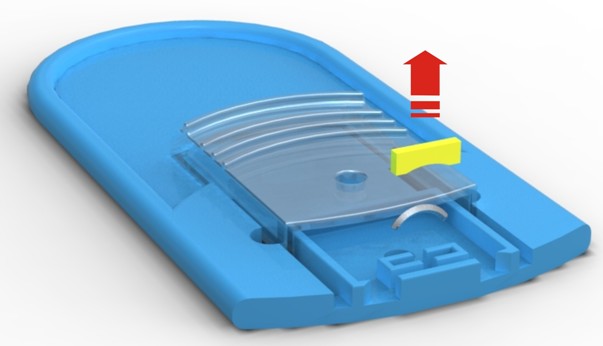
As the 90 and 120 degrees segments are very small,
they were placed below a security holder piece, preventing its
displacement.
So, after sliding the transparent lid of the case,
giving access to its internal cavity, the surgeon should:
1 - remove the safety holder piece (yellow device in
the picture above) in order to gain
access to the ring segment.
2 - remove the ring segment
The new informations acquired were stored on our data source. Using this new knowledge, the pertinent adjustments were carried through in the software.
Critics, suggestions, tips and comments: cornealring@cornealring.com